Volvo EX30 “Peace of Mind” Now Comes With a Fire Warning
Volvo still sells an idea before it sells a car: Safety. Reliability. Scandinavian restraint. On Volvo Car Canada’s website, “My Volvo Experience” is pitched as a “new perspective on ownership – created for less worrying and more living,” with the soothing reassurance that “Life is precious. So is living.” [1] It is a nice line.
However, for a growing number of Volvo owners, the modern “ownership experience” includes checking for recall notices, watching for software updates, and now, in the case of Volvo’s new EX30, being told to change how you charge your vehicle to reduce the risk of fire.
This week, Electrifying.com reported that Volvo has begun contacting owners of certain EX30 models (Single Motor Extended Range and Twin Motor Performance) with a safety warning: do not charge beyond 70%, due to concerns about high-voltage battery overheating and a potential fire risk. [2]
Volvo, to be clear, is not asking owners to charge a little lower for battery health. This is a manufacturer telling people to cut the usable range of a brand-new electric vehicle by nearly a third as an interim risk-reduction measure. [2]
Other recent issues
In July 2025, the U.S. National Highway Traffic Safety Administration issued an urgent warning about a Volvo recall remedy—advising some owners to install an over-the-air update immediately because, without it, an affected vehicle “could completely lose its ability to brake while going downhill.” [3] More unsettling is that the NHTSA said the defect “originates from” an earlier over-the-air remedy tied to a rearview camera recall. [3]
In May 2025, Volvo recalled 413,151 vehicles in the United States because a rearview camera malfunction could prevent the image from displaying when reversing. [4] In Canada, Transport Canada posted recall notices for similar rearview-camera software failures, including a campaign where the rear view may fail to display when shifted into reverse. [5]
In May 2024, regulators in Australia posted an EX30 recall notice stating that a software error could push the infotainment screen into a “test mode” during start-up—potentially preventing key information, including the vehicle’s speed, from being displayed. [6] In the EX30, the infotainment screen is also the dashboard.
In January 2024, Transport Canada posted a Volvo XC40 recall notice: a software problem could cause the left-rear turn signal not to work and could “increase the risk of a crash.” [7] A corresponding NHTSA documents describe the same defect mechanism and note recall populations in both the U.S. and Canada. [8]
A brand built on trust
Volvo’s safety reputation is not just good marketing. It was built on a social contract: the company would be conservative, careful, and honest about risk, especially when families are involved. Yet that contract is strained when basic functions (speed display, camera visibility, turn signal operation) can degrade through software faults. It is strained when a regulator is forced to urge drivers to install a recall remedy because braking can be lost in certain conditions. [3] And it is especially strained when the new safety protocol for a vehicle includes modifying charging behaviour to reduce the risk of fire.
The uncomfortable truth is that Volvo is now selling “peace of mind” at the same time it is asking owners to think like test engineers. If you own an EX30, check your messages from Volvo, confirm whether your vehicle is affected, and follow the manufacturer’s instructions. [2] But when you find yourself sliding that charge limit down to 70%, it is worth asking a larger question: “What does it mean when the owner becomes the last line of defence between a brand promise and a house fire?”
At some point, the question stops being whether Volvo can fix the car and becomes whether Volvo has become the risk.
References
[1] Volvo Car Canada. (n.d.). My Volvo Experience. Volvo Cars. https://www.volvocars.com/en-ca/l/My-Volvo-Experience
[2] Burnett, S. (2025, December 30). Volvo EX30 owners warned over battery fire hazard. Electrifying.com. https://www.electrifying.com/blog/article/volvo-warns-ex30-drivers-over-battery-fire-hazard
[3] National Highway Traffic Safety Administration. (2025, July 17). NHTSA Issues Urgent Brake Failure Warning for Select Volvo Vehicles. https://www.nhtsa.gov/press-releases/volvo-recall-urgent-brake-failure-warning-select-vehicles
[4] Reuters. (2025, May 7). Volvo Cars recalls over 400,000 US vehicles over rearview camera issue, NHTSA says. https://www.reuters.com/business/autos-transportation/volvo-cars-recalls-over-400000-us-vehicles-over-rearview-camera-issue-nhtsa-says-2025-05-07
[5] Transport Canada. (2025, May 1). Transport Canada Recall 2025233 – VOLVO. https://recalls-rappels.canada.ca/en/alert-recall/transport-canada-recall-2025233-volvo
[6] Australian Government – Vehicle Recalls. (2024, May 23). REC-005968 – Volvo EX30 (Campaign R10273). https://www.vehiclerecalls.gov.au/recalls/rec-005968
[7] Transport Canada. (2024, January 15). Transport Canada Recall 2024005 – VOLVO. https://recalls-rappels.canada.ca/en/alert-recall/transport-canada-recall-2024005-volvo
[8] National Highway Traffic Safety Administration. (2024, January 10). Part 573 Safety Recall Report 24V-010. https://static.nhtsa.gov/odi/rcl/2024/RCLRPT-24V010-4035.PDF
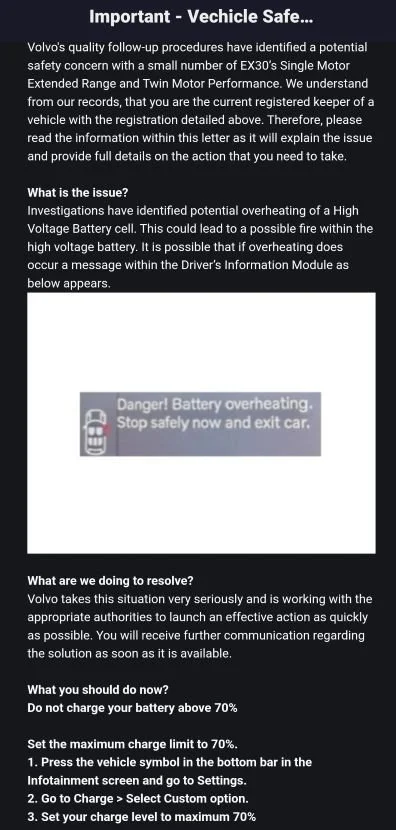
Safety message about Volvo EX30 battery fire risk received by some owners in December 2025.
Volvo Recall Information
Search by VIN to see if your vehicle might be affected by the Volvo EX30 battery issue.